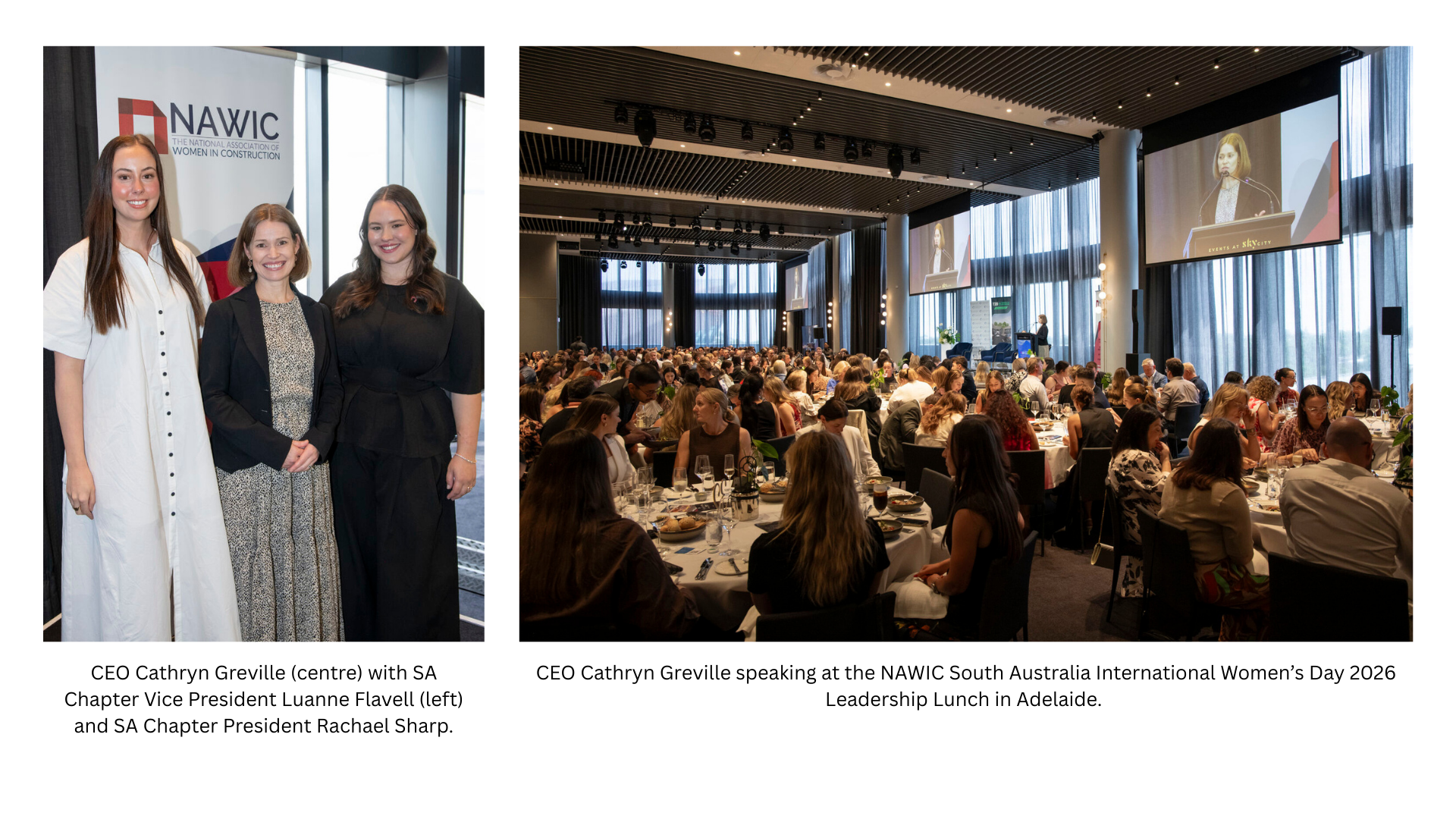
I begin by acknowledging the Kaurna (‘Ghana’) people of the Adelaide Plains, and pay my deepest respect and appreciation to elders past and present, and to all Aboriginal and Torres Strait Islander people here with us today.
On International Women's Day, we honour the women of construction who came before us, and talk about the work we still have to do.
Balance the Scales.
As UN Australia explains, this theme is a promise for every woman and girl to be safe, heard, and free to shape her own future.
Rachael has spoken about how we can each add weight to the scales, to support the balance we desperately need.
I will focus on what those scales actually weigh for the industry and community – that is, what it costs us all when they don’t balance.
Firstly, the scales of construction.
When I think about scales, I think about what we put on them.
1. On one side, we have the infrastructure program – $242 billion pipeline, the highest level ever recorded. Hospitals, schools, roads, rail, housing, the energy transition that will power the next generation.
2. On the other side – the workforce to deliver it.
Right now, those scales are far from balanced.
• We have a skills shortage that is already causing delays and cost blowouts on projects across the country.
• Our workforce gap is projected to hit 300,000 people by 2027.
• We do not have enough people to build what we have committed to.
• Women make up roughly 12% of the sector, and only about 2-3% of trades. 88% of the potential solution is sitting underutilised.
It’s like we are trying to fill a pipeline with one hand tied behind our back, and have been doing so for decades.
Secondly, the human cost.
This is not just a numbers issue. Behind every percentage point is a person.
• There is the apprentice who left after her second year because the site culture made her feel unsafe every day, grinding her down slowly. She questioned whether she belonged.
• There is the project manager who came back from parental leave to find her role had been quietly restructured. Who was told that the industry "moves fast" and perhaps a less demanding role would suit her now.
• There is the engineer who was brilliant and ambitious but had to fight for the right to be taken seriously. Talked over in meetings, left off email chains, asked to take notes when she was the most qualified person in the room. She eventually took her skills to another country.
Every one of those women is a loss. A loss of opportunity to shape their own future. And a loss to the projects that didn't get built better. To the teams that didn't get led differently. To the industry that didn't get to see what it was capable of.
So, the scales don't just weigh fairness. They weigh what we lose when we get this wrong.
Thirdly, the turning point. Where we are now.
The scales don't balance on their own. They are balanced deliberately – by people who decide that the imbalance is no longer acceptable. By organisations that stop treating equity as a cultural aspiration and start treating it as an operational requirement.
The evidence shows, when we reach that turning point, the shift starts to happen. The work gets better. The teams get stronger. The projects get delivered. Businesses are significantly more successful.
• Diversity helps make better decisions 87% of the time, and makes them twice as fast (Deloitte).
• Gender diverse companies outperform their peers with up to 2% higher annual returns (Black Rock, 2023).
• The more women you have in leadership, the higher likelihood of outperforming other companies (BCEC).
Because that is what happens when you stop leaving talent on the table.
I have seen this in action.
• Companies that have transformed their sites by building fair, inclusive and respectful cultures, and are now impacting their whole supply chain.
• Those who provide equitable facilities, properly fitting PPE, ensure safety at work, stand up to microaggressions, and are actively working to reduce their gender pay gap.
• Leaders and allies and ambassadors who commit to shifting the balance everyday, in a myriad of small but impactful ways.
• People who’ve decided that the old way of doing things is costing us too much, and who want to be part of the solution.
Those willing to step up to build the balance. They are seeing the results.
Through our initiatives like the Allyship in Action project, parental leave research and toolkit, and microaggressions research, training and resources, we are giving individuals and businesses the tools to be part of the solution – and the companies that are willing to look honestly at their culture and do the hard work are already seeing the results.
I think about that apprentice, that project manager, that engineer. What has been lost because they entered workplaces that weren’t designed for them.
Then I think about all the ways we can get this right. The women who have succeeded, demonstrating grit and determination and extraordinary talent. The support for businesses and their leaders to be part of the solution. The evidence that shows us what is possible.
We have billions of dollars of construction to deliver. We have a generation of women ready to build it. And right now, on International Women's Day, we have an invitation to decide what kind of humans – what kind of workplaces – and what kind of industry – we want to be.
Here at NAWIC, we don’t wait for balance, we are building it.
The scales are in our hands.
Let's build something worth standing on.
Thank you.